


Table of Contents
If you’ve ever opened a bottle and noticed layers forming, you’re not alone. Camel milk separation after thawing is completely normal—and actually tells you a lot about the milk’s natural structure and quality.
For many first-time buyers, especially families exploring healthier dairy options, this can feel confusing at first. Is it spoiled? Is it still safe? Should it look like that? These are common questions, especially if you’re used to store-bought milk that always looks perfectly uniform.
Here’s the key thing to understand: camel milk separation after thawing is a natural result of freezing and thawing—not a sign that anything is wrong. In fact, it often reflects minimal processing and a more natural state of the milk.
Let’s break it down clearly so you know exactly what’s happening—and what to do next.
What You'll Notice After Thawing — And Why It's a Sign of Quality
Camel milk is a natural emulsion: tiny fat globules suspended in a water-based liquid, held in balance by the milk fat globule membrane that surrounds each globule. It's the same basic structure you'd find in any real, minimally processed milk.
Here's what makes our milk different — and why we ship it frozen instead of ultra-pasteurized like most dairy on grocery shelves:
We gently pasteurize our camel milk at low temperatures to protect its naturally high concentration of bioactive proteins, immunoglobulins, lactoferrin, and vitamins. Camel milk's whey proteins are far more heat-stable than cow milk's, but only up to a point — push the heat too high and you destroy the very compounds people drink camel milk for in the first place. Ultra-pasteurization (the 280°F flash-heat process used to make cow milk shelf-stable) is off the table for us. It would gut the nutritional profile.
That leaves us with one job: get the milk to your door as close to its fresh state as possible. Freezing is the answer. It pauses the milk in time, locks in the nutrients our gentle pasteurization preserved, and gives you full control over when to thaw and drink it.
What you may see after thawing
Because our milk hasn't been homogenized into a permanent suspension or stripped of its natural fat structure, you might notice:
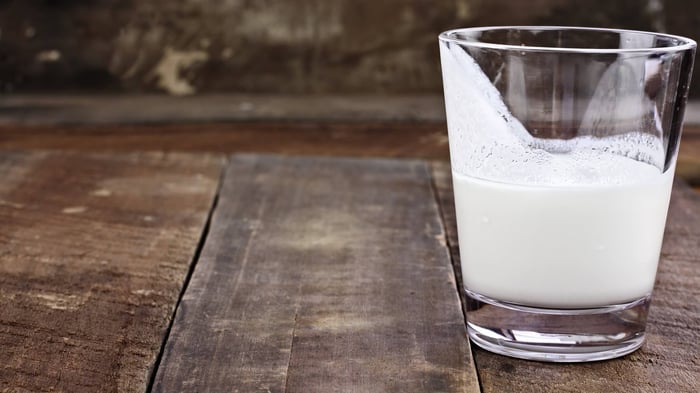
A faint cream layer rising to the top. Small flecks or particles in the liquid. A texture that looks slightly uneven before you stir.
This is not spoilage. It is not a defect. It's exactly what real, whole, minimally processed milk does when ice crystals briefly nudge fat globules closer together during freezing. A gentle shake or stir reintegrates everything in seconds.
If anything, separation is a tell that you're holding the real thing — milk that hasn't been over-processed into uniformity.
Is Separation a Sign of Spoilage?
Short answer: No.
Separation is not the same as spoilage.
Here’s how to tell the difference:
| Observation | What It Means |
|---|---|
| Slight layering or cream line | Normal after thawing |
| Smooth texture after shaking | Safe to drink |
| Sour smell or strong off odor | Discard |
| Clumpy + sour combination | Likely spoiled |
Camel milk is actually less prone to forming thick cream layers compared to cow milk because its fat globules are smaller and behave differently. This gives it a more naturally uniform appearance when fresh, which is why separation can feel surprising if you’re seeing it for the first time.
However, freezing changes that structure. The delicate balance between fat, water, and proteins gets temporarily disrupted, so when the milk thaws, those components may no longer stay evenly dispersed on their own.
So when you do see camel milk separation after thawing, it’s simply the structure reacting to temperature—not a quality issue. In most cases, a quick shake brings it right back to a smooth, drinkable consistency.
Camel Milk Nutrition Facts (Quick Overview)
Understanding the composition helps explain why separation happens in the first place.
Typical camel milk contains approximately:
- 3–4% fat
- 3–3.5% protein
- 4–4.5% lactose
- 87% water
It’s also known for:
- Smaller fat globules (easier dispersion)
- Different protein structure than cow milk
- Naturally occurring minerals like iron and zinc
Because of this structure, camel milk:
- Doesn’t behave like heavily processed dairy
- Responds more visibly to freezing and thawing
That’s why camel milk separation after thawing is more noticeable compared to standard store milk.
Why Camel Milk Behaves Differently Than Cow Milk
If you’re used to grocery store milk, this difference can feel surprising.
Here’s the reality: most cow milk is homogenized—a process that breaks fat into tiny uniform particles so it never separates.
Camel milk, especially when minimally processed:
- Retains its natural fat structure
- Has no forced homogenization
- Shows real, visible changes after freezing
This is actually a sign of less processing, not lower quality.
Think of it this way:
Separation is what milk naturally does when left alone.
Camel milk just shows it more honestly.
How to Properly Thaw and Mix Camel Milk
To get the best texture and taste, follow these simple steps:
1. Thaw Slowly
- Place the bottle in the refrigerator overnight
- Avoid microwaving or hot water
2. Shake Well
- Shake the bottle vigorously for 10–15 seconds
- This redistributes fat and proteins evenly
3. Swirl Before Each Use
- Natural separation can reoccur slightly
- A quick swirl fixes it instantly
4. Consume Within a Few Days
- Once thawed, keep refrigerated and use promptly
With proper handling, the texture becomes smooth again—and the taste stays consistent.
Common Mistakes to Avoid
Even experienced buyers sometimes run into issues. Here’s what to watch out for:
Rapid thawing
Can exaggerate separation and affect texture
Not shaking before use
Leads to uneven taste (cream-heavy or watery portions)
Leaving it out too long after thawing
Reduces freshness
Assuming separation = spoilage
This is the biggest misconception
Why This Matters for First-Time Buyers
For many families—especially those exploring alternatives due to lactose sensitivity or dietary preferences—camel milk is new territory.
Seeing separation can feel like something went wrong.
But in reality:
- It’s expected
- It’s safe
- It’s part of the milk’s natural behavior
Understanding camel milk separation after thawing helps you feel confident using it daily, whether for drinking, smoothies, or recipes. Once you know it’s a natural response to temperature—not spoilage—it becomes much easier to handle and enjoy without second-guessing.
If you’re trying camel milk for the first time, quality and handling matter. The way it’s sourced, frozen, and delivered plays a big role in how it looks and tastes after thawing.
At Juba Farms, our camel milk is carefully sourced from trusted farms, then shipped frozen to preserve freshness and nutrients. This process helps maintain its natural integrity while giving you a reliable product every time. Each order follows a consistent weekly shipping schedule, so you know exactly what to expect when it arrives.
You can choose the size that fits your household, whether you’re just getting started or using it regularly:
Camel Milk (16 oz)

$39.00
$48.00
Introducing Juba Farms' Pure Camel Milk: Nature's Liquid Gold We are proud to present our 100% Pure Lightly Pasteurized Camel Milk. This incredible super drink offers a remarkable range of health benefits and is sourced from the best camel farms,… read more
Camel Milk (1 Liter)

$63.00
$78.00
Introducing Juba Farms' Pure Camel Milk: Nature's Liquid Gold We are proud to present our 100% Pure Lightly Pasteurized Camel Milk. This incredbile super drink offers a remarkable range of health benefits and is sourced from the best camel farms,… read more
If you’ve noticed camel milk separation after thawing, now you know—it’s completely normal. There’s no need to worry or throw it out. Just give the bottle a good shake, pour, and enjoy.
In fact, once you get used to it, this small step becomes part of the routine. Many regular camel milk drinkers don’t even think twice about it—they simply shake and go. It’s a simple reminder that what you’re drinking hasn’t been overly processed or altered.
So instead of seeing separation as a problem, you can view it as a sign of the milk’s natural composition. With proper thawing and a quick mix, you’ll get the same smooth texture and consistent taste every time.
Ready to try it? Visit https://jubafarms.com/
FAQs
Why does my camel milk look curdled after thawing?
It may look uneven, but that’s usually just fat separation—not curdling. Shake it well, and it should return to a smooth consistency.
Is separated camel milk still safe to drink?
Yes, as long as it smells fresh and hasn’t been left out too long. Separation alone is not a safety issue.
Does separation affect nutrition?
No. The nutrients remain intact. You’re just seeing fat and liquid temporarily separate.
How can I reduce separation?
Thaw slowly in the fridge and avoid temperature shocks. Always shake before use.
Why doesn’t store-bought milk separate like this?
Most conventional milk is homogenized, which prevents visible separation. Camel milk is often less processed.